Sunday, July 26, 2015

Week Two on STV Tuna

After sailing around the Annapolis Basin for a week now.  We have gotten use to the tides and the currents.  Most days here are very hot with not a lot of wind.  But we have managed to sail almost every day so far.  The only thing that is really hard to get use to is the smell at the wharf.  Right now the lobster, scallop and hearing fisheries are in full swing.  Which means lots of smelly fishing boats.
Busy government wharf

Herring Boat

Herring Boat
We have made several stop in Annapolis Royal for coffee and lunch on our day trips.  It is 12.2 nm's from Digby.  There is another government wharf there that offers one floating dock to tie up too.  Every time we have been there the wharf has been empty.  There is a great farmers market on Wednesdays and Saturdays.  There is also free wireless at the dock.  At low tide there is about 6 feet of water at the floating dock
Annapolis Royal (high tide)

Annapolis Royal (low Tide)

Annapolis Royal (low tide)


Port-Royal National Historic Site is a National Historic Site of Canada located on the north bank of the Annapolis Basin in the community of Port Royal, Nova Scotia. This National Historic Site is the location of the Habitation at Port-Royal.

The Habitation at Port-Royal was established by France in 1605 and was that nation's first successful settlement in North America. Port-Royal served as the capital of Acadia until its destruction by British military forces in 1613. France relocated the settlement and capital 8 km (5.0 mi) upstream and to the south bank of the Annapolis River the site of the present-day town of Annapolis Royal.

The relocated settlement kept the same name "Port-Royal" and served as the capital of Acadia for the majority of the 17th century until the British conquest of the colony in 1710, at which time the settlement was renamed to Annapolis Royal.

This is one of the best places to visit if you are interested in the history of this area.  I spend more then an hour walking around this fort and learning of the history in this area.

Main Gate


Dinning Hall

Sunday, July 12, 2015

Week One on STV Tuna

STV Tuna at her berth at Fleet Diving Units Jetty, Shearwater Nova Scotia

STV TUNA
History
Two vessels TUNA (Halifax) and GOLDCREST (Esquimalt) were procured on April 1985. The Commander Maritime Command did establish a requirement to provide two sail training vessels suitable for offshore passages and races. Vessels of this type had previously been operated by Maritime Command (CFAV GOLDCREST, CFAV TUNA), but were disposed of without replacement in the early 1970’s. Sea trials were carried out 28 and 29 of Mar 85 at Port Credit, Ontario. Trials were carried out by NDHQ staff. On competition of trials the two vessels we move to the respective coasts.  Currently STV Tuna is dock at the FDU jetty (Shearwater).
C/S. CZJO
Sail #2372
MMSI 316015408
PHRF 132 (spinnaker). 150 non Spinnaker
MAIN TECHNICAL CHARACTERISTICS
Dimensions
L.O.A. – 36’6″
L.W.L. – 29’3″
Beam – 11’6″
Draft – 6’3″
Displacement – 15,500 lbs.
Sail Area – 822 sq. ft.
Ballast keel of approximately 6,500 lbs. is a lead casting
Engine Westerbeke 33 hp, 4 cycle diesel
Both Hull and Deck are glass reinforced plastic (G.R.P.)
The deck has a special nonskid pattern
Crew 8

Check us out on Facebook (STV Tuna) for more information https://www.facebook.com/groups/STV.TUNA/

Deliver crew from Halifax to Digby, Nova Scotia
Thursday, July 9th, 10am Departed Halifax for Liverpool, Nova Scotia.  After a safety briefing, tour of the boat and storage of store we set off.  After about 15 mins into the trip Mike realizes that he forgot his glasses so back we went to Shearwater.  We motored out of the habour and started down the coast towards Liverpool.  Our first plan was to anchor in a bay at Coffin Island but after a closer look at the charts and because our arrival was going to be after dark we decided to going into the yacht club in Liverpool for the night. Liverpool is 59 nm from Halifax.

Liverpool Yacht Club is located just in the habour on the right hand side just passed the rock break water.  This was my second time here and both times there were docks available, There were a few other boats here for overnight stay as well.  The price to stay here is $35.00 per night which include water, power (30 amp) and showers.  Its a small club and is located a distance from the town. So to get fuel you need to get one of the locals to drive you with Jerry cans.  I should add that there is a very small very well marked channel going into this yacht club.  We arrived at low tide and it show only nine feet of water in most places on our depth sounder.
Liverpool

Liverpool Yacht Club docks

Liverpool Yacht Club East docks

Liverpool Yacht Club, Club house


Friday, July 10th, departed Liverpool for Clarks Habour, Nova Scotia.  We left Liverpool at 7 am and headed back down the coast towards our next stop.  Still no wind and sea was like glass.  We saw a few other sailboat farther out to sea.  After looking on AIS we found out they were boats that were in the Marble Head race.  I guess they were all heading home.
We stuck close to the coast so we would have something to look at as the day went on.  We did see, Harbour seal, Minke whales, porpoise and a sunfish.


We ended up motoring a total of 74 nm to Clarks habour since there was no wind again.  We pulled into Clarks habour at 7 pm and tied up to the government wharf.  We found out there was no cost to spend the night there.  There was power on the wharf, but no water or fuel.  To get fuel you had to walk up the road to the gas station.  Which was just a 5 min walk.  There is also a well stocked corner store there as well. The corner store also sold propane.  The channel going into this habour is well marked and the habour is very well protected.  Lots of people we on the wharf fishing squid.  You could see them swimming around the wharf pillars.
Baptist Stone Church Clarks Habour

Clarks Habour


Clarks Habour Information

STV Tuna at government wharf

Clarks Habour

Lobster holding pens 


Saturday, July 11th.  We departed the Habour at 6 am on low tide so we would could make it to Digby Neck on rising tide. For the first few hours we were fighting the currents but by mid-morning the currents turned and we got sucks up along the coast.  Again no wind and the water was like glass.  But Terry Scott made some great meals for us so all was not lost.
When we got to Digby Neck we motored through the gap.  Before we entered the gap our water speed was 6 knots.  Half way through the gap our GPS speed jumped to over 10 knots.  With the Bay of Fundy still flooding we got a push all the way to Digby.  Average speed was 7.5 GPS. We arrived at Digby just before midnight.  Total distance of this trip was 242 nm's


The first week of cadet training went well.  We took 7 cadets and 1 escort officer out each day.
Government wharf Digby - high tide

Government wharf Digby - low tide
The tides in Digby habour is normally 22 feet. So docking on a floating dock is a must.

I was surprise by my wife RaeAnn a few days after I got here.  We decided to stay at the Digby Pines hotel while she was here.  I is a grand old hotel with great rooms, very clean and has a great restaurant. The rates per night are not that bad either at only $142.00 per night.  The history of the hotel is very interesting.
Digby Pines from the water


Main Hall

Main door

Outdoor chess set


ReaAnn and Todd enjoying the Digby Pines

Monday, July 6, 2015

CANADA DAY ADMIRAL’S SAIL PAST

THE ADMIRAL’S SAIL PAST HISTORY


Each year, on Canada Day, an interesting event occurs in Halifax Harbour that has its roots in an old British tradition. It is the day when many private yachts from the local clubs sail past the Commander MARLANT in salute. Here is the history.

Early in his reign, King Henry VIII started a build up of the Royal Navy, but soon realized that the number of ships needed could not be paid for with the public purse. After consultation with his government, it was decided to offer a subsidy on newly built ships of private ship owners, in return for which the recipient would agree to make his vessel and crew available to the crown in time of war; an arrangement which is still in effect to this day. During the Falklands war many ships were Ships Taken Up From Trade, S.T.U.F.T.

As a means of reaffirming this contract and to show that these vessels were sound and in good operation, it was required that on a particular day each year, these vessels would sail past and salute the king on his Royal Barge moored on the Thames, while the Royal Secretary recorded the names of each vessel as they sailed past.
Since these were commercial vessels and could well be elsewhere on this appointed day, many ship owners petitioned for exclusion from this requirement. The king, fearing abuse of this exclusion, came up with a compromise, that these ships could sail past the Port Admiral of whatever Naval port they were nearest to, and the Admiral’s secretary could record the names and forward them to the Admiralty.

Soon, other ship owners, without subsidy, joined the Sail Past in an open demonstration of loyalty to the crown, and these vessels were included in the list of ships available during time of conflict. As the centuries rolled on, the tradition of the Admiral’s Sail Past grew and became an occasion of much festivity and colour, looked forward to each year by ship owners and the general public alike.
During the early and mid 19th century yachting became a popular pastime of the wealthy upper class and the aristocracy in Britain. Many people owned yachts of considerable size and potential to the Royal Navy, and because members of the Royal family were involved in yachting, many of these yachts started to take part in the Admiral’s Sail Past, adding much colour to the event.
As modern yachtsmen we should remember Dunkirk, where many small boats, including privately owned yachts, sailed to the shores of France to rescue the Army from certain death or imprisonment. Many of these vessels did not return from the mission.

Throughout the world, wherever traditions of the Royal Navy persist, this noble and worthwhile tradition continues. The event, as practiced in Halifax Harbour each year, is now carried out as an expression of respect and acknowledgement to the Navy for all they have done in the past and are prepared to do in the future.

Shearwater Yacht club hosts this event each year. This year the motor/sail past was received by a  Reviewing Dignitary aboard HMCS CHARLOTTETOWN, who received the salute.


How to salute

Vessels shall salute two boat lengths before the reviewing stand.

The procedure for saluting is as follows:
A salute will consist of dipping the ensign, and
The crew will face the Reviewing Officer with caps removed.

Note: Boats without ensigns will salute by luffing the jib, or in the case of vessels under power, with enthusiastic (but polite) waves to the Reviewing Dignitary.

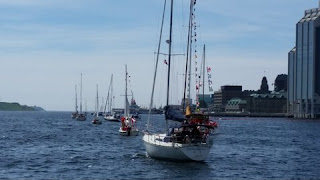
STV Tuna leading the sail past

Sail Past on Halifax waterfront

Sail Past on Halifax waterfront

Sail Past on Halifax waterfront

Sail Past on Halifax waterfront

Sail Past on Halifax waterfront

Sail Past on Halifax waterfront

Motor boat waiting off of navy dockyard

Sail Past on Halifax waterfront

Sail Past on Halifax waterfront

RaeAnn and Renee enjoying a drink on the deck at the Bicycle Thief 

deck at the Bicycle Thief 

deck at the Bicycle Thief 

deck at the Bicycle Thief